Monday, 26 May 2008

The heavens opened...


Yesterday we experienced our first downpour...and it lasted for hours. The storm began on Sunday morning while we were sweating in our seats listening to a sermon at church. We saw the wind whipping up the dust in a frenzy, and people rushed to close the windows before they banged shut (obviously they've learnt from experience as some panes were already cracked).

The pastor tried to keep his flock on track, but he had a hard job, competing with the wind and rain while the children tumbled back into the building from their outdoor Sunday school classroom. But he soon adjusted to the conditions and added an extra 30 minutes to the sermon (because no-one could leave if they wanted to).

When we finally got out of church it was like stepping into a new world, such was the difference in temperature. I (Cathlin) actually had goose bumps on my arms from the fresh chill in the air! It was a wonderful feeling, to be cold.

Meanwhile, the streets had been transformed into rivers so we waded home through the murky water, trying not to think about what we were stepping in. Only the main roads and downtown streets are paved in Ouaga, so when it rains dusty streets disappear. It was eerily quiet on our way home. Life stops when it rains here, as the Burkinabé think they'll get a cold if they go out... and if they get sick they won't be able to go to work (or afford a doctor) and so will lose their income.

As we approached our house the neighbourhood watch (kids in our street) came to greet us. Some were dressed in long-sleeved tops and jackets, even though after the initial chill the temperature had since risen back into the mid-twenties.

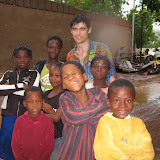
I saw one guy in a beanie. Crazy stuff. One little kid had improvised a rain hat by perching a large hessian flour bag on his head. Jon went out in the rain to take photos (that's our street in the pic above) and entertain the kids.
In our street - Jon & kids

This is him in the brightest shirt I've managed to get him to wear. The bucket was my idea to collect rain water for our water filter...then the kids came in and washed their hands in it. Oh well. We were so thankful for the beautiful rain.

Cathlin

Monday, 19 May 2008

African church ululation


We've visited 3 different churches here in Ouaga, and each one has lived up to my expectations of African worship - lively, joyful and with a smattering of dance moves. Oh, and women ululating (long, high-pitched sounds) at any given moment. It's all a lot of fun to be part of. The first church we visited was a Baptist one up the road from our place. It was quite large, with ceiling fans, a data projector, full band and a choir in matching 'uniform'. The music was great, and everyone around us (who wasn't white, which was most people) knew all the actions to the songs. I found myself wriggling my hips along with the rest of them - you just feel stupid standing there motionless.

The 2nd week we went with some missionaries to a church which is part of the 'Evangelical Churches' union here and is supported by SIM (our mission organisation). It was a long car ride away in a village-like setting where everyone lives in mud brick houses. This church was a world away from the Baptist one of the previous week's visit. The church was a simple small building with backless benches for seats, and mats on the floor for the kids. Instruments were improvised and sounded fantastic! I don't think they even do music rehearsal before church. One guy played a bongo drum, and just picked up a beat after the ladies in the choir started singing. Another guy sat on a wooden box and played it like a drum. So natural!

Jon committed a cultural faux pas by sitting down with me on the left side - only to realise that he was surrounded by women and all the men were sitting on the right side. Thankfully another missionary couple came in, and sat together on the women's side. They whispered some helpful advice, that it was sometimes good to break with tradition and show others that it is more important to keep families together. Jon stayed put.

The whole service was in French and Moore (pronounced 'moray'), which is the dialect most spoken in Ouaga. The songs were all in Moore and there were no song books (and obviously no data projector). This church was obviously poorer than the Baptist one, but the people were very welcoming. Everyone wanted to shake our hand afterwards, and we had to stand up and introduce ourselves during the service.

Yesterday we went with some other missionaries to another SIM church that meets in someone's garage. They were having a special 'women's day' where women from all the SIM churches in Ouaga come together and perform in their choirs. It means a much longer service than normal...try 4 hours, from about 8am to midday. The church association prints special fabric to celebrate such events, so it looked like a lot of people were in uniform. But such a cool uniform it is - 'Jesus saves' and selected Bible verses are printed on the fabric.

The service was long and the room was hot. I carry a straw fan with me, and a large bottle of water, while the Africans carry neither. Again the service was in French and Moore, and again there were really unique instruments. One lady carried a large bowl with cowrie shells attached to its rim. She threw this repeatedly in the air in time to the music, spinning it slightly as she threw. A man clanged 2 pieces of metal together - with rhythm.

The visiting pastor spoke in Moore (with a French translator) about the importance of forgiveness, as the theme for the day was 'pardon'. He was dressed for the occasion in a white shirt and sparkly-striped vest and bow tie.

And Jon sat with the women again.

Cathlin

Sunday, 11 May 2008

Mammoth mangoes (and other food) in Ouaga


It’s 4pm and 28 degrees in our bedroom, where we’ve just had the air con on for about 1.5 hours. The rest of the house feels like a sauna. In fact, I don’t need to moisturise my skin much here as the humidity is enough. We got up from our siesta about half an hour ago. Jon, who has always been a great napper, loves the daily siesta, and I am slowly taking to it. Not everyone takes a siesta here, and we don’t always, but it is a nice break in the heat of the day, especially if we have risen early to beat the heat.

It's 2 weeks into our stay and we have so much we could write. There have been ups and downs, especially for me. Mostly feelings of acute culture shock because everything is so different here; which is not a bad thing, it’s just that it requires more time to get used to. The heat is really intense, zapping our energy so that a trip to the market to get fruit is about all we can handle for a few hours. Once I realised that everyone sweats a lot here, and thus smells a lot too, I felt more comfortable! The heat is intense, and seems unbearable at times…and then we remember that we have the blessing of fans in the lounge room, air con in the bedroom, and a fridge - and our next door neighbours don’t have any of those. To them, we live in absolute luxury.

Our neighbours have become some of our first Burkinabe friends. Pictured here is Raqieta (pronounced ‘Racketta’), whom I met on my way to the market the other day, as she was sitting outside her house and asked me if I wanted her company. Shopping with a local is much better as she tells me when I’ve been given an inflated price by the vendors (there’s a ‘white’ price and an ‘African’ price). She’s helped me buy some fabric to take to the tailor to get clothes made. There are tailors (always male as far as we’ve seen) everywhere in Burkina, perhaps as much as there are boulangeries/patisseries in Paris.

Raquieta lives with 9 other people including her “uncle” (not her real uncle but somehow in the family) Jean, who is our night guard. All the children who hang around their house (some live there, some across the road) call out ‘Nasara’ whenever we walk past. This means ‘white thing’ in one of the local dialects. Burkinabe kids find us hilarious and fascinating, because we have pale skin and straight hair (they often line up to shake our hands). One girl even asked me if my hair was real – women here sometimes wear wigs of straight black hair so she assumed mine must be a wig too!

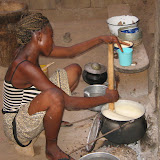
Last night, Raqieta was making the African staple food, ‘To’ (pronounced ‘toe’) for her family. They eat this most nights. It’s a dish with corn flour and water that is stirred until it becomes thick like porridge, and is eaten with a sauce that’s similar to our gravy. Sometimes they have pieces of meat in the sauce. I took some photos of Raqieta preparing the ‘To’, and of her family. They love getting photos, but we ask permission each time in case it offends them. There is a belief among many Burkinabe that when a white person takes a photo, they are going to take it back to their country and use it to make/raise money (so we can't just walk around town taking snaps). See photos of our neighbours and our house here:
First pics in Ouaga


So we tried our first real Burkinabe meal, and it wasn’t at all bad. Raquieta brought some ‘To’ over to our place and stayed with us on our porch as we ate it. We got her to try some Vegemite and the verdict was ‘good’ – although Burkinabe are very polite so we don’t know for sure if she really liked it.

The food that we generally eat here is not too different from home in some ways. We just have to be more resourceful and adapt recipes because you can’t buy all the ingredients that you’d get at home.

Because many imported foods like cereal and yoghurt are so expensive here, we’ve begun making our own. Jon made a great batch of muesli this week, complete with dried pineapple, banana chips (yum!) and coconut shavings. I’ve learnt how to make yoghurt – because it’s so hot here you just leave the mixture to incubate on the kitchen bench for 6 hours then pop it in the fridge!

Unfortunately we don’t think we’ll be able to make our own ice cream. In the shops a regular brand from France costs about $20 a litre.

We get really cheap mangoes, tomatoes and avocados from the markets – about 30 cents for a mango. The huge one pictured at the top of this post is a 'pineapple mango' – so it tastes like a combination of the two. We also have some mango trees in our front yard.

All salad and unpeeled fruit and veges have to be washed in a bleach solution here, and then rinsed in filtered water (because of all sorts of bacteria). The first time I did this I left the lettuce for too long (over 10 mins) and it tasted terrible! As a result we don’t eat much salad and prefer fruit that we peel first.

There is a meat market just 2 mins from our house. Every morning at about 8-9am meat that has been freshly killed arrives here and the butchers chop it up and sell it throughout the morning (and sometimes into the afternoon). The meat market is a huge shed with glass-less windows and no refrigeration. As such, we’ve been told to only get meat there early in the morning before the flies get to it. Outside the meat ‘shed’ vultures wait patiently for the butchers to throw the scraps they can’t sell onto the ground. When this happens, 8 or more vultures nose dive from the roof of the house opposite and fight it out for their prize. They really are ugly creatures up close.

We ventured out one night in search of food as we didn’t have the makings of a meal in our fridge. People operate open-air food stalls where you bring your own bowl and buy rice or cous cous and some kind of sauce for about $1 all up. We’re not sure what’s in the sauce so haven’t dared to try it yet, but will do so when we can go with a local. They also sell a lot of dried fish from the coastal countries, which we’ve been told to stay away from. The one time we have had fish here was in a restaurant and it was ‘safe’ – it was a type called ‘capitaine’ in French (no idea what this is in English).

There is a man here who sells and delivers baked goods to many of the missionaries. We ordered from him this week and were so excited to discover his ‘German hamburgers’. These are white round buns with a filling of savoury mince and cabbage baked into the middle. I think they’re going to be a weekly lunch order for us.

We've been having power cuts most days around lunch time (but before siesta time!) so we keep lots of frozen water bottles in our fridge to keep our food cold. The cuts don't usually last more than 20 minutes, but can go up to 4 hours.

Casualties of the power cuts, to date, include a tub of yoghurt and some cheese.

Cathlin

Wednesday, 7 May 2008

Thank God for the geckos.


We arrived at our new home to find geckos on the walls, in the cupboards, in the pots and pans, in the toilet and just about everywhere else. While I’m not against geckos per se (I think they have attractive qualities such as very cool web feet), living in such close proximity is a little unsettling, especially when they come near your cereal bowl.
At the time of our arrival, I was reading a book about Corrie Ten Boom; a woman who was placed in the concentration camps after becoming active in the Dutch underground. She also helped protect Jewish people during WWII (thank you to those who gave Cathlin the book). Corrie records her sister (who took part in the same work and went to the same camp) giving thanks to God when discovering there were fleas in the concentration camp sleeping quarters.
Why did they give thanks? Because the Bible says in 1 Thessalonians to “give thanks in all circumstances”, and they trusted that God was in control of the dire situation. Turns out, the guards stayed away from the sleeping quarters because of the fleas, leaving the prisoners free to read, be comforted and teach from their “illegal” Bible.
I thought I too could give thanks to God ... but this time for the lizardy creatures (of course I’d prefer geckos 100-times over to fleas.)
The next day I was advised they are great to have in the house because they eat mosquitoes and other insects that carry some of the most-feared diseases in Africa.
So, thank God for the geckos. They can share my cereal anytime.

Jon

Sunday, 4 May 2008

Settling into Ouagadougou


The scrap metal collectors are just outside our front gate, the meat market on the corner comes complete with swooping vultures, there are shanty-style shops all around and a row of beggars just down the street.
Some chickens are running around our front yard, and there are goats and oxen kicking up dust outside, near the 10 or so people seeking shade under the biggest tree on the street.
Any romantic notions we tied to Burkina before arriving have quickly disappeared, and we have been busy adjusting to life in one of the poorest countries in the world.
The heat and humidity, as we expected, are extreme (it was 30 deg-plus when we touched down in Ouagadougou at 3am one week ago), which will take some getting used to. However, we're thankful for the air con in our bedroom - we couldn't sleep without it.
After spending a couple of days in the missionary compound, we've moved into a house about 10 minutes away, which was being used by another Australian missionary who is back home for a few months.
Along with discovering the necessities to life in Burkina (buying food from the local markets, getting a working water filter, hand washing clothes in large tubs et al), last week we met the students to whom we will be teaching English, and the Bible. We are both teaching classes this Tuesday and Thursday, and Cathlin will be taking over the running of the ESL program (there's six classes of about 15 students each), on top of the teaching role.
I (Jon) am spending some time tomorrow (Monday) learning about the computer outreach work, where Burkinabe are trained in using Word, Excel and the Internet, and are exposed to the Gospel during the training.
There are 100-other ministry opportunities that we will learn more about in due time.
We have just experienced our first dust storm (and are very thankful to the missionary who called us just in time to tell us to close all our windows), but unfortunately the anticipated cooling rain didn't come, leaving the temperature in the high 30s on a Sunday evening.

Jon & Cathlin