Last year, angry bicycle and motorbike riders staged protests by burning things in the streets and knocking down traffic lights. What in the earth caused such a laid-back population to do such a thing?
The waitress at our favourite ice cream bar - and only ice cream bar in town - explained to us recently why people don't wear helmets in Burkina Faso. We were talking about Australia, and how you have to wear a helmet if you ride a bicycle or a motorbike, and she remarked that it's mostly white people who wear helmets in Burkina. She herself owns a helmet but doesn't wear it because it's too hot and, well, it disturbs a woman's carefully coiffed hair (usually extensions or a wig).
We asked her why the government doesn't introduce a law making helmets compulsory, especially when the majority of the adult population uses a 'moto' as their main form of transport (cars are only for the very rich). Apparently, such a law was introduced last year in the capital. However, the people were not happy having this law imposed on them...so they revolted.
Police were given the power to confiscate the moto of any rider who wasn't wearing a helmet. The offender then had to go to a special police station where all the motos were taken, and pay a fine to retrieve their moto. This did not please the Burkinabé, even though the law was put in place to help reduce the number of road accidents (we see them almost every day).
So these unhappy 'moto-ists' staged protests by burning things in the streets and knocking down traffic lights...basically causing havoc until the law was reversed. Perhaps the RTA needs to lend their road safety campaign to this country - 'if you don't need a head, you don't need a helmet.'
Cathlin
Saturday, 18 October 2008

Sunday, 12 October 2008
 Photo: An old mosque in Bobo
As we traveled to the southern city of Bobo-Dioulasso (a five-hour bus ride from the capital) last month, we heard the passengers at the front of the bus gasp.
We then heard a thud, thud, thud... as something, or someone, went under the bus.
We feared we'd just witnessed another useless death on the roads of West Africa, caused by a bus driver going way too fast, swerving around people on bicycles and motos who disobey road rules and don't wear helmets.
Thankfully, somehow, the moto rider survived. After a brief interlude, the bus driver started up the engine again, and hurtled towards Bobo.
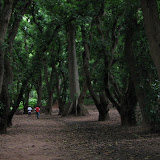
On a lighter note, we visited some waterfalls and accompanying forest near Bobo, which are quite remarkable as they are surrounded by hot, dry, dusty sub-Saharan terrain. (Click on the photo below to see some more pics.)
 |
| Bobo |
Saturday, 4 October 2008
The art of negotiation
Most things in Burkina Faso are negotiable, including taxi rides, food, appliances and clothing, to name a few. As a white person (‘nasara’) we can expect the starting price to be three times the real price…which means buying the simplest item takes quite a bit of time, patience and negotiation.
I’ve discovered that westerners living in West Africa take two different approaches to negotiating; they either negotiate passively and pay a premium, or negotiate until they get the African price.
The thinking behind the passive negotiator is that prices aren’t that high anyway, and the vendors don’t make a lot of money, so paying an extra 30 cents for a pineapple is ok (especially for those foreigners enjoying strong home currencies). My wife, and generally all the other nice people I know, fit into this first category.
I (Jon), on the other hand, have adopted the motto, “It’s either the African price, or I’m going elsewhere.” I have a desire - perhaps too big of a desire - to be treated equally and my thinking is that no-one really benefits if you teach someone they can inflate the price on you. The art to this type of negotiation is to keep bargaining until the vendor is happy to let you walk away…then you know you’ve hit the real price (or just under).
You can then go back and buy the item or know for next time what the real price is. The biggest pitfall to this approach is that by refusing to budge you can make life exceptionally difficult for the sake of a dollar (like the time I knocked back a reliable taxi ride to the bus terminal for the sake of $1.50, only to spend a whole afternoon and night wondering whether the cheaper taxi would actually pick us up from our house in the morning).
Interestingly, if the competition watchdog operated in Burkina, it would have to close down many corner stores, because they collude. Vendors are known to work together to protect their premiums. All vendors in a given radius selling the same type of product will almost always have the same ‘real’ price (finding it is the difficult thing)…and they will never undercut another seller. This means you end up with 10 people crowding around you all selling a big bag of peanuts for $2.50, refusing to budge on their price.
I actually think this is a good thing because you do hear of sad stories of people being severely underpaid – in an environment of rising food and petrol prices – because a low-paid job is better than no job. And with so many fruit and vegetable sellers, there is so much power with the buyer that they can potentially negotiate their way to an unfair price.
Jon
I’ve discovered that westerners living in West Africa take two different approaches to negotiating; they either negotiate passively and pay a premium, or negotiate until they get the African price.
The thinking behind the passive negotiator is that prices aren’t that high anyway, and the vendors don’t make a lot of money, so paying an extra 30 cents for a pineapple is ok (especially for those foreigners enjoying strong home currencies). My wife, and generally all the other nice people I know, fit into this first category.
I (Jon), on the other hand, have adopted the motto, “It’s either the African price, or I’m going elsewhere.” I have a desire - perhaps too big of a desire - to be treated equally and my thinking is that no-one really benefits if you teach someone they can inflate the price on you. The art to this type of negotiation is to keep bargaining until the vendor is happy to let you walk away…then you know you’ve hit the real price (or just under).
You can then go back and buy the item or know for next time what the real price is. The biggest pitfall to this approach is that by refusing to budge you can make life exceptionally difficult for the sake of a dollar (like the time I knocked back a reliable taxi ride to the bus terminal for the sake of $1.50, only to spend a whole afternoon and night wondering whether the cheaper taxi would actually pick us up from our house in the morning).
Interestingly, if the competition watchdog operated in Burkina, it would have to close down many corner stores, because they collude. Vendors are known to work together to protect their premiums. All vendors in a given radius selling the same type of product will almost always have the same ‘real’ price (finding it is the difficult thing)…and they will never undercut another seller. This means you end up with 10 people crowding around you all selling a big bag of peanuts for $2.50, refusing to budge on their price.
I actually think this is a good thing because you do hear of sad stories of people being severely underpaid – in an environment of rising food and petrol prices – because a low-paid job is better than no job. And with so many fruit and vegetable sellers, there is so much power with the buyer that they can potentially negotiate their way to an unfair price.
Jon
Subscribe to:
Posts (Atom)
