Sunday, 27 July 2008

Never felt so white


[Photo: Introducing Max - our friend's pet turtle (not a nasara)]

When our neighbours ‘King Davey’ and ‘Boris the Curious’ see us leaving or returning home on our bicycles, they start yelling “nasara, nasara, nasara”.

This means white person in a local language called Moré. For the three and four-year olds, respectively, seeing two white people is an event well worth telling everyone about. They then race over to us and offer a limp hand shake (sometimes forgetting which hand to offer).

Their nicknames – our inventions – are a good description because Davey (le Roi) thinks he owns the street, and Boris (le curieux) is incredibly mischievous and curious. Both are adorable.

Every day, I (Jon) spend a couple of minutes explaining to them my name isn’t in fact ‘nasara’. I repeat my name several times until they join in the game and I think they have memorised it. I then say “bye bye” which is coincidently the same words they use in Moré to say goodbye (not sure of the origins of this, but I presume they have just borrowed the English).

Davey and Boris then say “Bye bye ... (pause) … nasara” before racing off.

For children, the use of the word “nasara” is not an insult; it is simply a funny word. But during a typical day, a couple of adults (mostly young men) will say “nasara” as we walk past, which is meant to insult. Sometimes we stop and try to talk with the people. At other times we simply ignore it and keep walking. (Being referred to as “nasara” really, really bugs Cathlin.)

There is also the extra African francs added to food prices and constant hassling for a hand-out to serve as constant reminders we won’t ever really fit in.

We also have stories of how generous and polite the people are here. The man who guards our house on Sundays while we are at church (great time to rob a missionary), calls me 'le patron' (the boss) despite attempts to get him to call me Jon.

But even though I’ve progressed to warrant the special hand-shake - ends with a click of the fingers - with some of the nationals, and I visit their houses and we spend hours talking, we are all aware our circumstances keep us separated.

It is no doubt the most commonly quoted ‘difficulty’ of being a missionary in the region, even when the missionary has dedicated their entire life to the people.
The experience has, however, helped our ministry enormously. It is a constant reminder that the ultimate goal is to do ourselves out of a job, by training Burkinabé to take over the work.

If the ministry involves teaching English to open job opportunities and help people secure a better future, then we should be teaching potential teachers to take over this work. If the ministry involves sharing the good news of Jesus Christ, then we should be striving to take a back seat by strengthening Burkinabé to take over this work.

Jon

Sunday, 20 July 2008

Cure for social ailments

Not dissimilar to finding an amazing medical cure in the middle of the Amazon, we had to go to West Africa to stumble across the solutions to four of life's trickiest situations.

These include: making a dignified departure from a social function; filling an uncomfortable silence during a conversation; running into someone you really should have contacted weeks or months earlier; and appropriate greetings (to kiss or not to kiss).

We've all struggled making a dignified exit from a function, often resorting to blaming a friend or partner for having to leave, because for some reason we feel the need to excuse ourselves.

"[Fill spouse name here] has to get up early tomorrow." Or, "I'm getting a lift with [name of friend] so unfortunately I have to go", are two common exit strategies.

The friend or partner (the blamee) just raises their eyebrows with a look of sorrow, then mouths the word 'sorry' ...pause...then 'thank you' to the host before heading for the door, which works well in a crowded event.

In Burkina Faso, the etiquette is to say, "Je demande la route", which literally translates to "I am asking the way/direction". The host ignores the statement two times, but after the third time the host says, "Je vous accord la route" ("I agree to give you the way")

The host then walks the guest to the door or gate. Everyone is aware of the etiquette, so there is no need to come up with a parting statement or excuse.

The Burkinabé have also come up with a way to make sure a potentially awkward silence is filled. "On est là, on est ensemble", translates, "We are here, we are together."

It is a statement used to reaffirm 'togetherness' and can be dropped into a conversation at any time, and several times if needs be.

Then there is that unplanned encounter with someone you feel guilty for not having contacted earlier.

In Burkina this is not a problem at all. You just say, "Ca fait deux jours". This translates, "It makes two days", meaning we haven't seen each other in two days. You can say this regardless of how long the absence has been...it may have been several years, but you still greet each other with "Ca fait deux jours".

Perfect.

Finally, the question of whether you greet with a kiss, a hug (half hug or full hug) or shake hands never raises its head here.

You shake hands with everyone. Be it your wife, husband, boyfriend, girlfriend, boss, shop assistant, mother or random guy down the street...you only shake hands.

Jon

Friday, 11 July 2008

It's Fada than it looks

Thanks to Rob Smith for the witty headline (others may say it's a dad joke, but it works...and Rob's a dad so it is permitted).

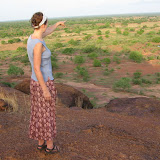
We've put up a couple of pics taken during our time in Fada, which is less than 200km from Niger. We walked up 'Fada Mountain' (not its real name), and got a taste for the African plains.

The mountain is kind of like a small-scale Uluru. On the way up, we passed a hut where people sacrifice animals as part of their rituals. Sadly, we were told albino babies (human) are sometimes sacrificed.


I was quite sick in Fada (please see blog post below), but feeling much better now. 'Prescription only' notices on drugs are ignored here - you can get most drugs over the counter at the pharmacy, which is often open 24 hours...handy if you were to get an onset of malaria at 3am.

Cathlin (click on the photo below for more pics)

It's Fada than it looks (July '08)

Sunday, 6 July 2008

The ride home


As the passenger’s head flopped to one side, looking for a shoulder to fall asleep on, and a father nursing a child used my leg for support, one thought ran through our heads.

“I’m so glad it’s Sunday morning.”

The bus ride back from Fada – a little town four hours drive from our home in Ouagadougou – provided a great African experience… we hope not to repeat in the near future.

To understand just how uncomfortable this trip was, I first have to rewind a couple of weeks, and provide a bit of background.

Cathlin and I have spent the last 10 days in Fada; one week of which was spent running an English/Bible outreach course for 17 students. Not long after we arrived Cathlin came down with what we thought was malaria, creating our most challenging week on the mission field thus far.

Without the medical facilities of the capital city, missionaries self-diagnose and-self treat in Fada. Showing all the signs of malaria – fever, headaches, and several other symptoms – we started the appropriate treatment, while making last minute plans to keep the course going, with three different missionaries taking over Cathlin’s classes.

Cathlin’s temperature returned to normal after some medication, which we thought was a sign of a quick recovery… but then the vomiting started.

So we were left with the decision: do we make a dash to return to the capital to get properly diagnosed, or start treating for a different ailment?

Convinced the four-hour bus trip was out of the question, we stayed put (and finished teaching the course), changed medication, and waited until Sunday morning to make the journey… as Cathlin was feeling a bit better.

But when we arrived at the bus terminal, the old mini-bus was already close to capacity, which meant we were in the aisle. There were some flimsy fold-out chairs, so we were able to sit down… however we had to stand up at every stop to let people climb past, and leg room was non-existent.

At every stop, people would crowd around the bus, selling everything from cold water to eggs and hot chicken to passengers.

So, I was uncomfortable, but healthy… and Cathlin was uncomfortable and feeling miserable. But throughout the journey we were thinking the exact same thing: “I’m so glad it’s Sunday morning.”

Why?

Well, deodorant is a luxury item here, and Saturday night is shower night.

(This may sound like we are having a bit of fun at the Burkinabe expense, but in this humidity and heat, body odor can be extreme... and there are times you simply need to leave an enclosed space.)

For the record, Cathlin is recovering, but still weak… so if you believe in the power of prayer… please pray for her.

Unfortunately, we couldn’t take pictures of our plight, as it would have been culturally inappropriate… but just imagine two white people crammed into a 24-seater, carrying about 30 Africans… and you’ll get the picture.

Jon